Introduction
Something is fracturing. The social fabric that sustains human existence – the shared spaces, the common world, the capacity to be genuinely with one another – is under increasing pressure. Loneliness has become a mass phenomenon, no longer merely a personal misfortune but a structural feature of contemporary life. Democratic publics are eroding as authoritarian politics attacks the conditions under which a shared world becomes possible. Inequality turns recognition – the experience of being seen, heard, and acknowledged – into a privilege rather than a birthright. And now artificial intelligence begins to simulate the very forms of human presence on which belonging, care, and therapy depend.
These developments are not merely political or social. They reach into the ontological conditions of human existence itself: into what Heidegger called Mitsein – the embodied, temporal, and vulnerable being-with-others through which selfhood and world are constituted. They demand not only policy responses but thinking – the kind of thinking that does justice to the full weight of what is at stake. This conference proceeds from the conviction that Mitsein remains our unfinished business – unfinished for philosophy, for the social sciences, and for psychotherapy alike. A structure acknowledged, but never sufficiently elaborated in its ontological, ethical, political, and clinical implications. It asks what is at stake when we take seriously that existence is always already co-constituted: for our understanding of selfhood, suffering, social life, political order, and the practice of psychotherapy.
Central Question
We have not yet thought shared existence sufficiently. What does it mean to say that we are never simply alone, that selfhood arises only in and through a world shared with others – and that this shared world is now, visibly and urgently, under strain?
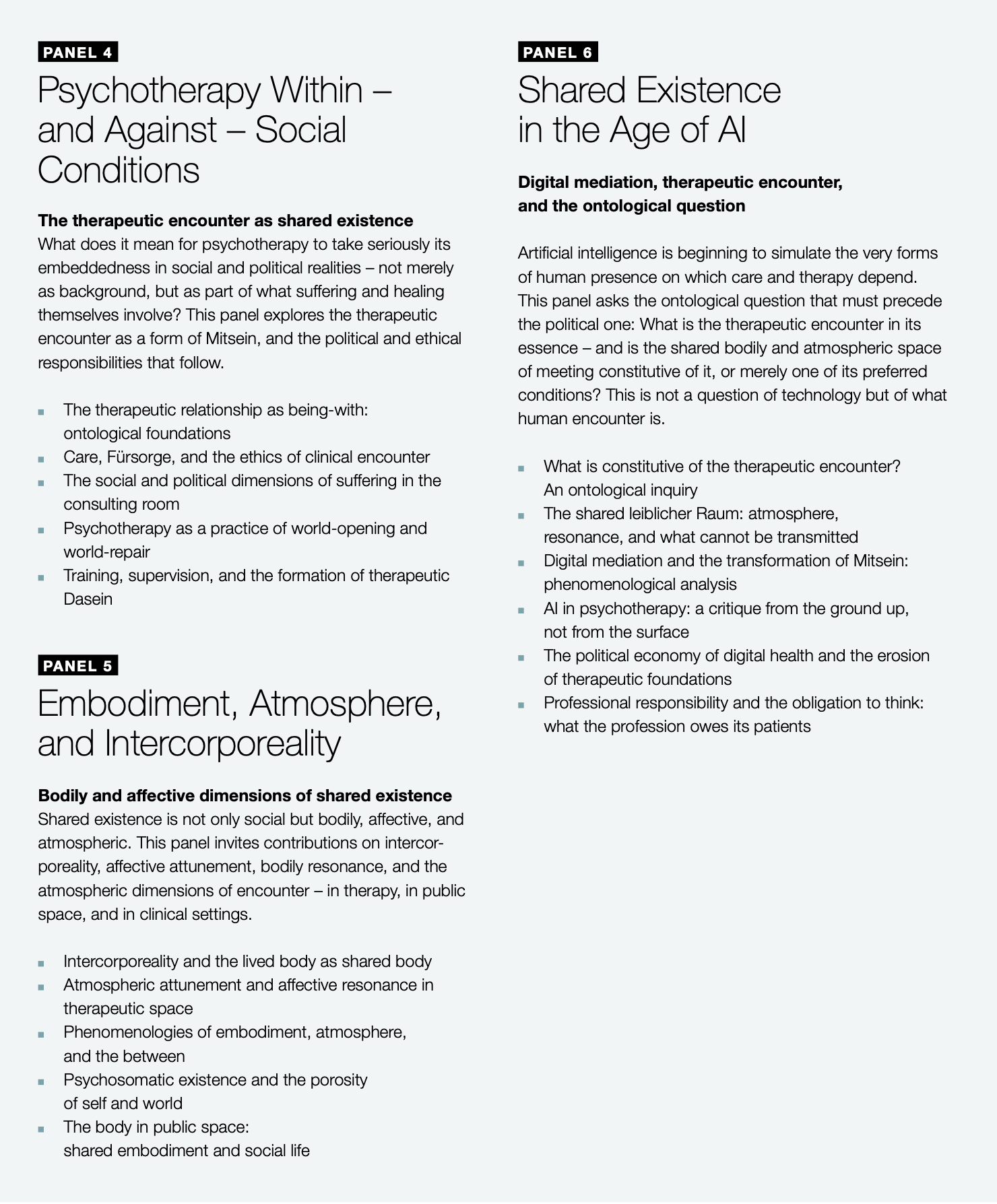
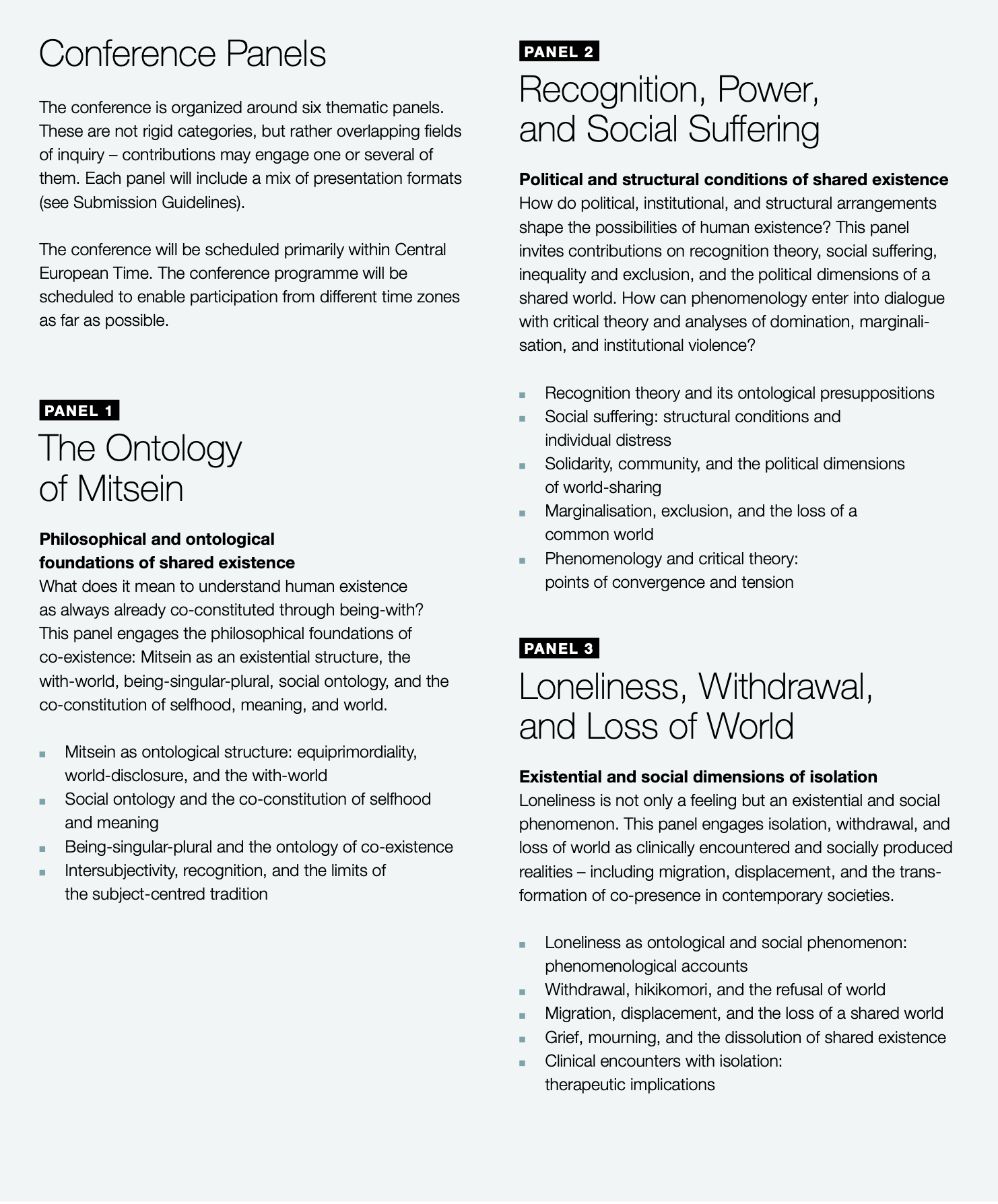
We Especially Welcome Contributions That…
bring philosophical concepts of being-with into dialogue with clinical or therapeutic practice
explore social and political forms of suffering from a phenomenological or psychotherapeutic perspective,
reflect on loneliness, withdrawal, exclusion, or loss of world in contemporary societies
examine the therapeutic encounter as a form of shared existence
develop interdisciplinary conversations between philosophy, psychotherapy, social theory, and critical theory
Philosophy, Psychotherapy, and the Social Sciences
Philosophy and psychotherapy rarely speak directly to one another. They have their own languages, institutions, and standards of rigour. And yet, at their best, they remain answerable to the same reality: the reality of a human being thrown into a world, suffering, searching, trying to live. When they enter into genuine dialogue – rather than merely borrowing concepts from one another – a field opens up that neither can reach alone. Philosophy gains traction in the concrete; psychotherapy gains philosophical depth in its understanding of suffering, relationality, and world. The Zollikon Seminars remain the most sustained example of what this can look like: over seventeen years of thinking with physicians and psychiatrists, Martin Heidegger hoped – in Medard Boss’s words – to break out of the philosopher’s study and reach those who suffer. Out of that encounter grew Daseinsanalysis: a form of psychotherapy that takes philosophy not as a mere accessory, but as its ground. Yet even there, Mitsein – the ‘with’ of existence – was left largely unthought: the encounter was primarily between a philosopher and individual clinicians. The social, the political, the co-constituted world in which suffering is produced and situated remained in the background. This conference is an attempt to bring it into the foreground: to think Mitsein with the same seriousness, and to do so together – across philosophy, psychotherapy, and the social sciences. Mitsein is not first a concept we apply to a situation – it is always already happening in the moment of being together. The interdisciplinary encounter this conference invites is itself an instance of what it seeks to think.
Submission Guideline
Please submit the following via our online submission form by 31 October 2026. All submissions will be reviewed between 1 and 15 November 2026. Notifications of acceptance will be sent by 20 November 2026.
Submission form:
https://forms.gle/rfaVVqi7hRvKDiBD9
Each submission should include:
An abstract or proposal max. 300 words; see format-specific guidance below
A short biographical note max. 100 words
Your preferred panel and presentation format
Presentation Formats
Individual Presentation
30 min + 10 min discussion
For completed research or theoretical contributions. Please submit an abstract describing the argument, theoretical framework, and significance of the contribution.
Shared Thinking Session
10 min impulse + 40 min moderated dialogue
For open questions, unresolved problems, and collaborative inquiry. Rather than presenting a completed argument, the presenter opens a question or tension and invites the group to think through it together. Please submit a short proposal (max. 300 words) describing: (1) the question or problem you wish to open; (2) why it resists easy resolution; and (3) what kind of dialogue you hope to generate. Sessions will be moderated by a designated chair who facilitates the dialogue without directing it toward a conclusion. This format is especially encouraged — it enacts the conference’s conviction that thinking shared existence requires thinking together.
Tandem Contribution
30 min + 20 min discussion
For two presenters from different disciplinary or practical backgrounds — such as philosophy and psychotherapy, social theory and clinical practice, or research and institutional experience — working together on a shared problem, case, or question. Please submit a joint proposal (max. 300 words) describing the problem and how the two perspectives will be brought into dialogue.
Target Audience
This conference is intended for researchers, practitioners, and thinkers working at the intersection of philosophy, psychotherapy, and the social sciences. It is especially relevant for:
Philosophers working in phenomenology, social ontology, and political philosophy
Psychotherapists and psychoanalysts with a theoretical or foundational orientation
Sociologists, social theorists, and scholars in recognition theory and critical theory
Psychiatrists and clinicians interested in phenomenological approaches
Scholars in phenomenological psychopathology, medical humanities, and the philosophy of psychiatry
Daseinsanalysts and practitioners in existential and related therapeutic fields
The conference is not confined to Daseinsanalysis or to any single therapeutic school. It is an invitation to anyone who takes seriously the question of shared existence — philosophically, clinically, or politically — and who is willing to think across disciplinary boundaries.
Organized by the Austrian Daseinsanalytic Institute (ÖDAI)
& coordinated by Stephan Dietrich and Kurt C.M. Mertel.
Contact: stephan.dietrich@daseinsanalyse.at